
Let’s reduce freight transport’s negative externalities.
What is Logistics is the process of ensuring the efficient flow of raw materials, products being manufactured, finished goods and/or waste through all storage, distribution and consolidation points. It also includes the information and technologies related to this physical flow.
It is considered sustainable when it respects the following aspects:
The RTI (reduce, transfer, improve) approach, recommended by many in the sustainable mobility industry, is a simple and effective guide.
The goal is to
Establish new practices such as consolidation, mutualization, decentralization and multimodality to reduce mileage and shift to more environmentally friendly modes of transportation.
Development, adoption and integration of new technologies such as trucks and other small electric vehicles, road planning algorithms, etc.
Build or develop new infrastructure such as bike paths, charging stations, and mini transshipment hubs to accelerate adoption of practices and technologies.
The motivation to accelerate changes and facilitate new soft and light uses such as sustainable urban logistics.
Federate and break down existing gaps in order to better understand and address the obstacles to the adoption of new practices and technologies.
+190 %
of GHG emissions from heavy vehicles in Quebec between 1991 and 2018.

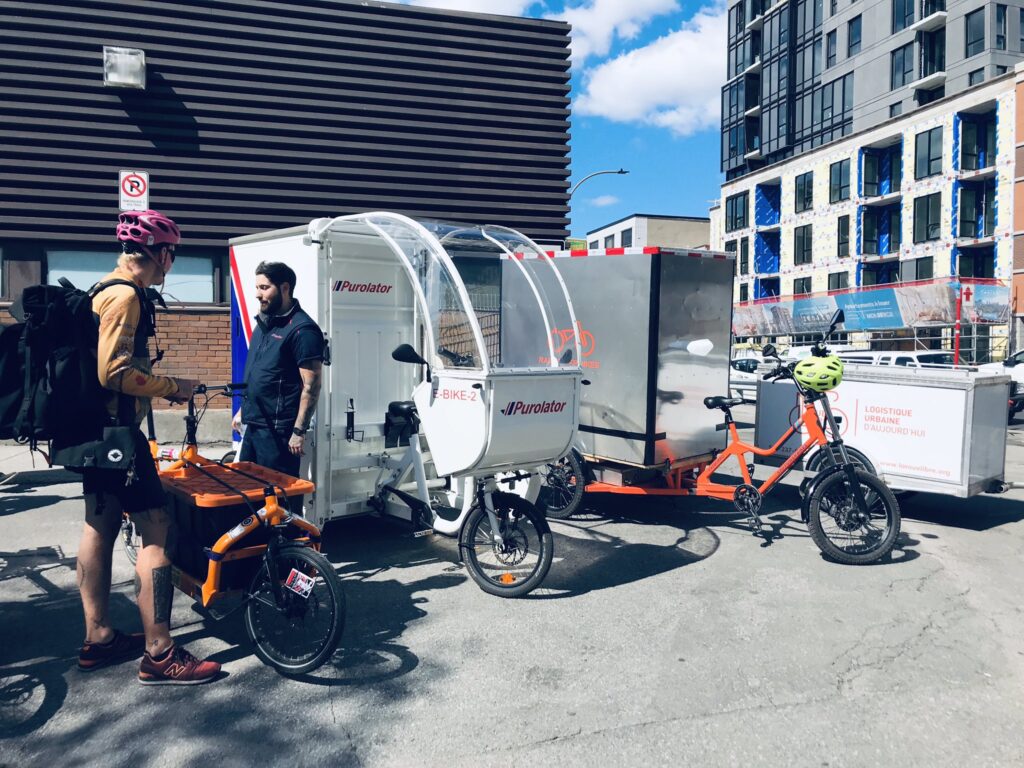
As the first urban logistics space operating under real market conditions in Montreal, it is also one of the few functional shared spaces of its kind in the world.
Formal recognition granted for a sustainable last-mile delivery service that meets specific standards of quality, processes, and performance.
A modal shift pilot project to merchants to help address supply issues during the summer season in collaboration with the Société de Développement de l’Avenue du Mont-Royal.
Here are the other programs in sustainable mobility developed by Coop Carbone.